
Beyond Competition: Understanding the Forces Behind "The China Squeeze"
China’s manufacturing dominance is squeezing both developing and advanced economies by limiting their opportunities to build competitive industries.
Globalization usually offers countries a fairly structured ladder of economic development. Poor nations begin with textiles, footwear, toys, and basic assembly before moving towards machinery, technology, and higher-value production. But what happens when one country tries to take control of nearly every level of production at once? China’s manufacturing power creates resentment from other countries not just because it defeats individual competitors, but because it leaves progressively less economic space for everyone else. Advanced economies fear losing the sophisticated industries they already possess, while poorer countries fear losing the basic manufacturing opportunities they need in order to develop. China’s rise has therefore created much more than ordinary commercial competition.
China did not build its manufacturing power alone. Its rise was enabled in part by access to foreign markets, investment from international sources, imported technology, and an originally welcoming global trading system. When China entered the World Trade Organization (WTO), many governments believed that deeper economic integration would gradually make the country more open, market-oriented, and economically interdependent with the rest of the world. Foreign companies gained access to Chinese workers and consumers, while China gained access to some of the wealthiest markets in history. Indeed, for many years, both sides benefited from this exchange. However, resentment started building up when other countries began to see China as using the openness of the global system to strengthen its own industries without reciprocating equivalent access or opportunity.12
Historically, the cycle of industrialization goes something like this: countries that became wealthier tailored towards advanced manufacturing and sophisticated industries, gradually losing their edge in low-cost manufacturing. As wages increased, low-level production moved towards poorer nations with cheaper labor. This process creates opportunities for developing countries. China deviates from this pattern; even as Chinese wages have risen and the country has entered more advanced industries, it has remained highly competitive in many traditional manufacturing categories, holding on to much of what it already controlled. Now, China’s industries encompass an extraordinary range of production. It is still deeply involved in textiles, furniture, toys, household goods, steel, chemicals, and electronics assembly. At the same time, it has become a leading producer of electric vehicles, batteries, solar panels, telecommunications equipment, industrial machinery, drones, and increasingly sophisticated semiconductor technologies.
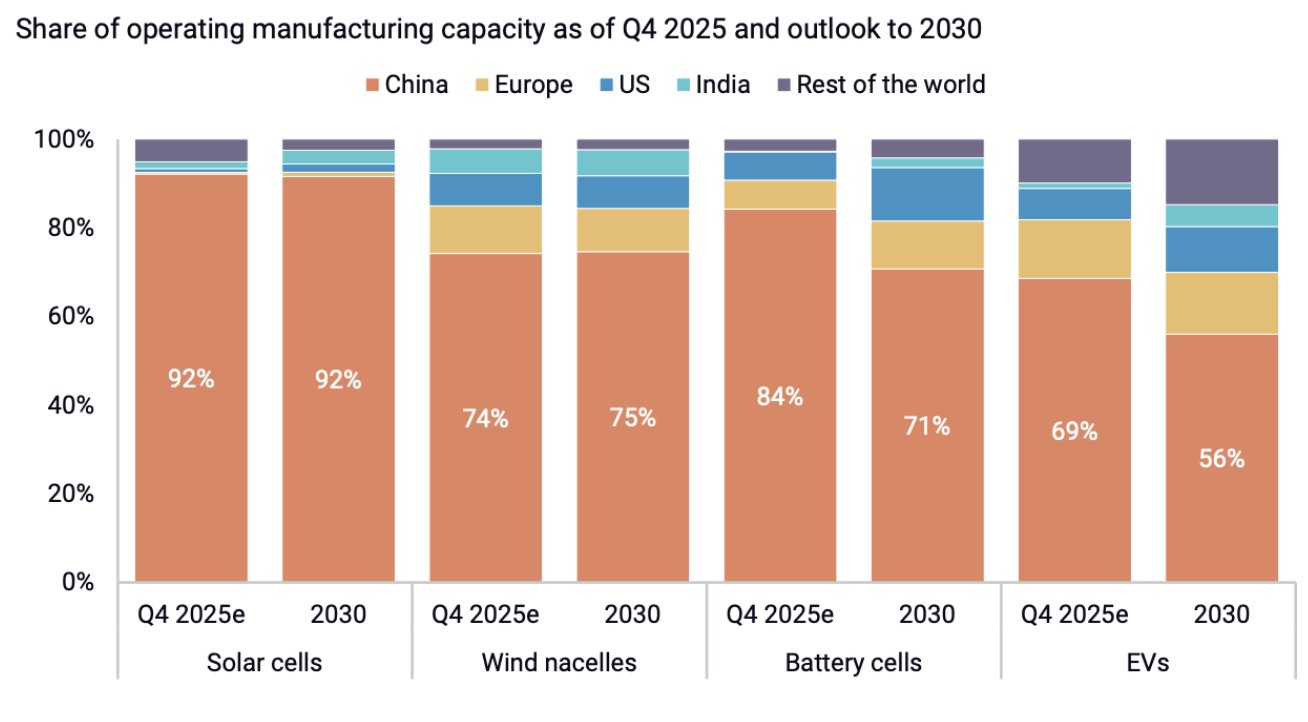
Figure 1. China’s Share of Global Clean-Technology Manufacturing Capacity. As of Q4 2025, China accounted for 92% of global solar-cell manufacturing capacity, 74% of wind-nacelle capacity, 84% of battery-cell capacity, and 69% of electric-vehicle manufacturing capacity.
This pressure has been coined the “China squeeze.” Poor, developing countries not only need access to cheap products, but also the opportunity to produce goods themselves, employ large numbers of workers, develop supply chains, and build up their industries. China retaining its dominant position in the “poorer” sectors directly makes their path towards development narrower and increasingly difficult for late-blooming countries.3
The scale of this squeeze is enormous. Chatterjee and Subramanian estimate that China produced more than $355 billion in excess value-added exports across low-skill industries in 2022, including approximately $110 billion in apparel, textiles, leather, and footwear. These exports represent industrial space that could have supported tens of millions of manufacturing jobs in poorer economies. Sub-Saharan Africa is especially affected. The region currently exports only about $12 billion in low-skill goods, even though estimates indicate that greater room in global markets could allow those exports to multiply several times. Therefore, China’s gain is not simply another country’s loss; it can mean a factory never built, workers never trained, and an entire supply chain never developed.4
A difficult quandary arises for developing regions such as those within Africa. Chinese clothing, electronics, machinery, vehicles, and solar panels provide consumers with products that are often better and cheaper than local alternatives. However, those same affordable prices make it extremely difficult for young domestic industries to survive: A country may benefit from cheap imports in the present while losing its chance to build productive capacity for the future. Chinese trade is making poorer countries stronger consumers while preventing them from becoming competitive producers.5
Advanced economies face the opposite end of the squeeze. They fear losing automobiles, batteries, machinery, electronics, and clean-energy industries that provide technological leadership and high-paying jobs. The Federal Reserve describes the present surge as “China Shock 2.0” because China is expanding from an already dominant position into industries once led by advanced economies. China’s share of global goods exports rose from 13.1 percent in 2018 to 16.3 percent in 2024, while its trade surplus reached a record $1.2 trillion in 2025. That surplus now exceeds one percent of the combined GDP of the rest of the world and is proportionally larger than the peak surpluses of earlier export powers such as Germany and Japan.6
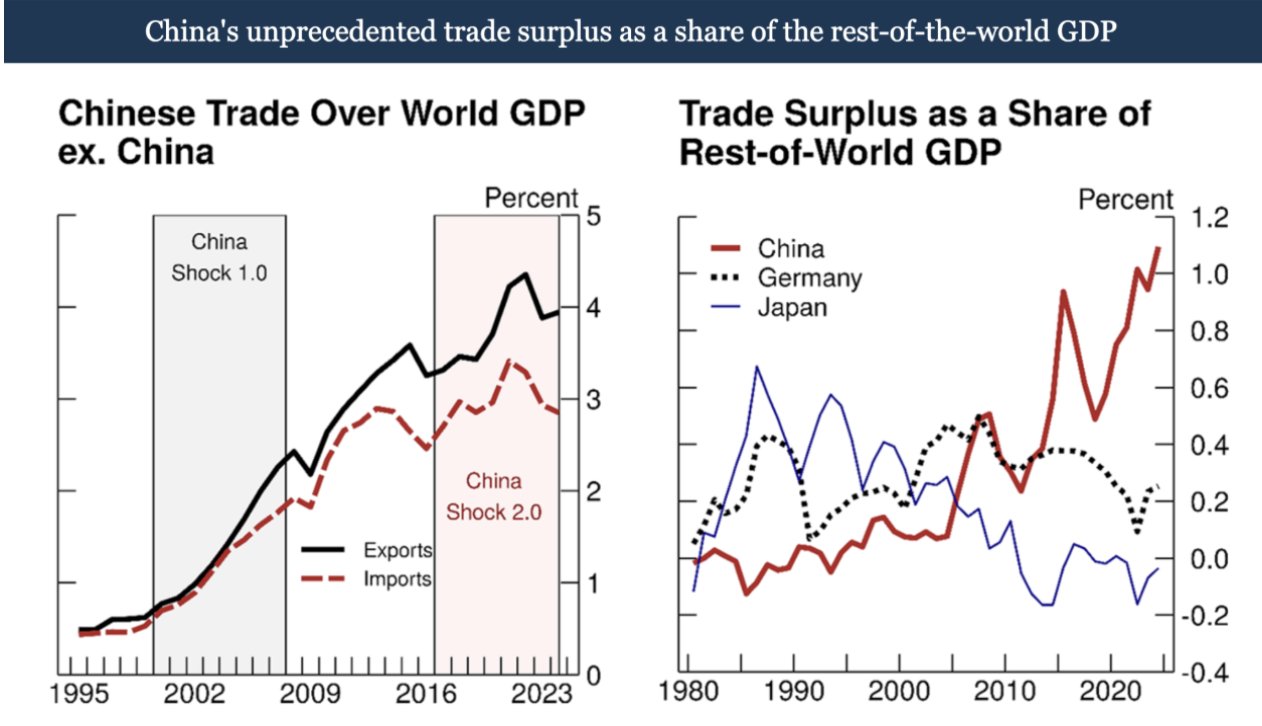
Figure 2. China’s Trade Surplus as a Share of Rest-of-World GDP. China’s current surplus has risen above the historical peaks reached by Germany and Japan.
Part of this global pressure comes from an imbalance inside China itself. The International Monetary Fund reported that Chinese private domestic demand remained weak in 2025, while net exports contributed 1.6 percentage points to economic growth and the current-account surplus rose to an estimated 3.3 percent of GDP. When domestic consumers do not absorb enough of their production, Chinese factories must depend more heavily on foreign demand. The IMF therefore recommended shifting support toward household consumption and away from inefficient investment and unnecessary industrial support. Such a shift would allow China’s economy to grow without relying as heavily on other countries to purchase its excess output.7
From Beijing’s perspective, foreign resistance may seem hypocritical. Western countries promoted free trade while their own companies dominated global markets, but they turned toward tariffs and subsidies once Chinese firms had a fighting chance and began competing. China also possesses genuine advantages in infrastructure, logistics, scale, automation, and supplier networks. The result is that regardless of whether China’s dominance comes from efficiency or industrial policy, struggles arise for all other countries: rich countries struggle to defend their advanced industries, while poor countries struggle to establish their first ones.
Ultimately, we must move away from the question of whether China deserves to compete, but what responsibilities accompany the leadership in the global economy it is working to claim. China presents itself as a defender of open trade and a partner of the developing world. However, a leader cannot realistically capture nearly every stage of production while leaving other countries with no path toward industrial development. If Beijing wants its rise to generate real lasting influence rather than growing resistance, it must expand domestic consumption, open its markets more widely, and leave meaningful room for poorer nations to build industries of their own. True leadership is not demonstrated by producing everything the world needs. It is demonstrated by supporting a global system in which other countries are also able to rise.
Notes
- François de Soyres, Ece Fisgin, Ana Maria Santacreu, Eva Van Leemput, and Kevin Vega, “China Shock 2.0: How China’s Ongoing Export Surge Differs from the Early 2000s,” FEDS Notes, Board of Governors of the Federal Reserve System, May 29, 2026, https://www.federalreserve.gov/econres/notes/feds-notes/china-shock-2-0-how-china-ongoing-export-surge-differs-from-the-early-2000s-20260529.html. ↩
- de Soyres et al., “China Shock 2.0.” ↩
- Chatterjee and Subramanian, “China Is Pulling Up the Ladder Behind It.” ↩
- Chatterjee and Subramanian, “China Is Pulling Up the Ladder Behind It.” ↩
- Chatterjee and Subramanian, “China Is Pulling Up the Ladder Behind It.” ↩
- de Soyres et al., “China Shock 2.0.” ↩
- International Monetary Fund, “IMF Executive Board Concludes 2025 Article IV Consultation with China,” press release no. 26/53, February 18, 2026, https://www.imf.org/en/news/articles/2026/02/18/pr-26053-china-imf-executive-board-concludes-2025-article-iv-consultation. ↩
Enjoyed this article?
Subscribe to get the latest economic analysis delivered to your inbox.
Comments
Related Articles
The Price of Progress: Inside China's Semiconductor Industry
This article summarizes three interviews the writer conducted with industry professionals in China on the topics of Competition,...

The Housing Crisis in China: Causes, Effects, and Global Comparisons
China's housing crisis comes down to a fundamental problem: in many cities, urban shortages persist as hundreds of millions of residential...

Why Is Everything So Expensive?
From inflation and housing shortages to gas prices and corporate pricing, here's what's really driving the rising cost of living.