
Quantum: Is It the Future?
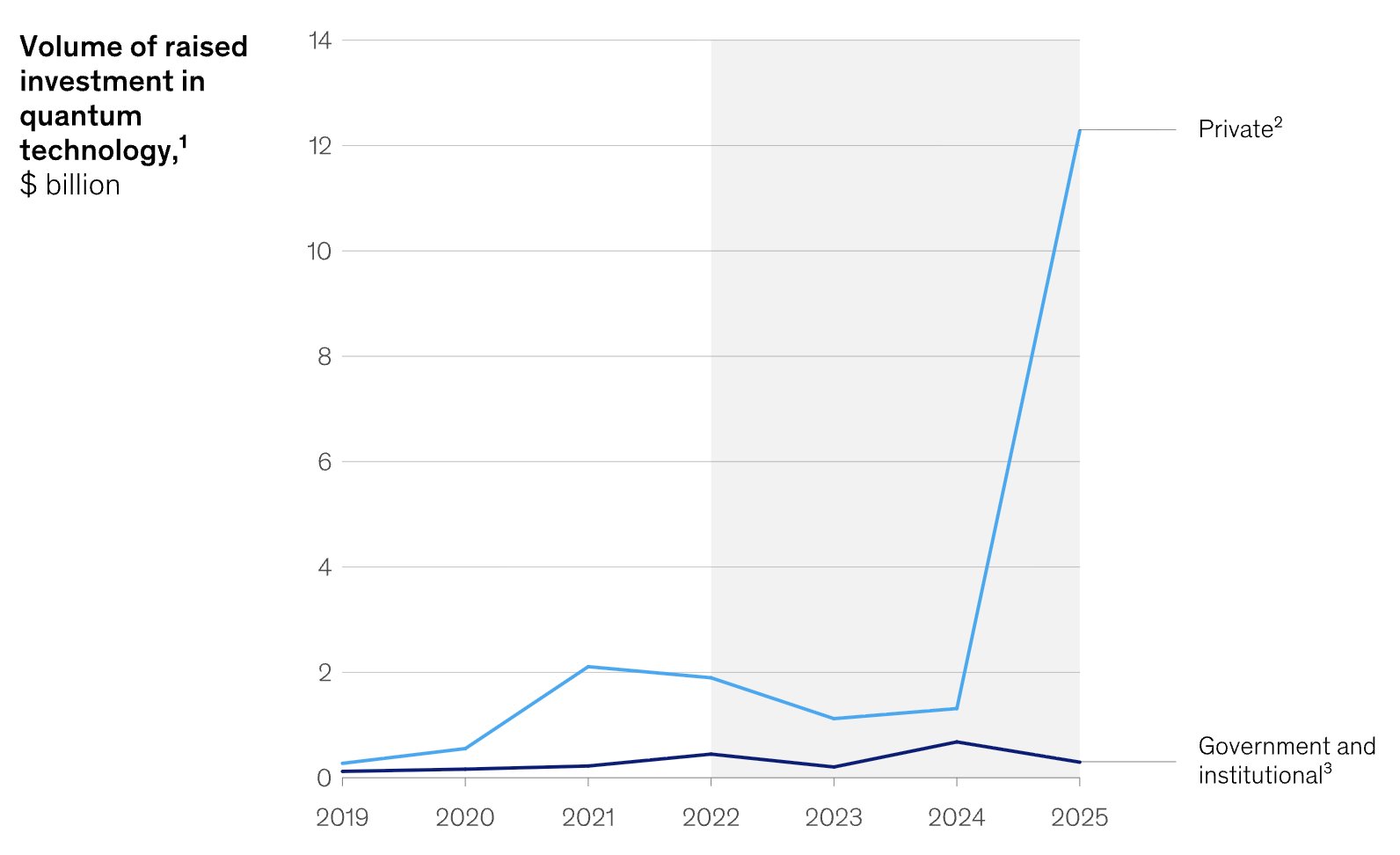
As billions in capital pour into quantum computing, the race to build reliable qubits has captivated companies seeking to capture the market of one of the world’s most promising technologies, and turn it into a commercially viable reality.
Introduction
Practical quantum computers may be a ways away, but in that time we must consider how they will be useful to the world and reason whether they have the capacity to become “the next big thing”. That time grows increasingly short as AI models get more efficient, lowering the time it takes to research and discover new things. Classical computers will most likely always be the primary medium for mainstream technology use, yet elements of quantum computing will help us solve complex problems that are otherwise impossible to solve with classical computers.
Why Quantum is Useful: Qubits Vs. Bits
Classical computers use bits, a very basic unit of information–either a zero or a one, whereas quantum computers use qubits. Qubits are unique as they can be both a zero and a one at the same time. Qubits have key properties that make them stand out from bits. One of these properties is superposition, which allows qubits to be in all possible states at once. Another one of these key properties is entanglement: one qubit can act in the same way as another qubit when linked together, no matter the distance between them. With quantum technology, we can map out complex scenarios by considering every solution at once. We can also break Bitcoin and easily hack a 256-bit encryption, which is the encryption currently used to keep your money safe in the bank. Quantum computers and QPUs (quantum processing units) connect to classical computers and solve problems; although they are currently too weak to break Bitcoin, they can be used to solve very specific math and chemistry problems in their current state.
Current Impracticality
Although the ceiling for the capacity of what quantum computers can accomplish and forcefully rewire for humanity is quite high, quantum computers remain quite impractical.
Rigetti Computing’s Novera QPU with a measly 9 qubits sits at a price tag of $900k.1 A classical computer with a screenshot’s worth of storage can simulate 9 qubits. This impracticality most likely won’t last, as with just 53 qubits you can solve a problem in 200 seconds that a classical computer would take 10,00 years to complete. Google did this with “Sycamore” in 2019. Also, due to the qubit’s unique property of superposition, adding one qubit to a quantum computer doubles the number of possible states it can represent at once. That is, adding just one extra qubit adds a meaningful increase in computational power.
Quantum Companies in 2026
Like the efficiency of AI models, the efficiency of quantum computers grows as companies design systems with more qubits every couple of months. A company called IONQ has been very consistent with its roadmap and is on track to attain a system with 80,000 logical qubits by 2030. Although promising so far, quantum computing still has major hurdles to overcome before it can reach those levels. Qubits lose their quantum properties when they interact with the outside world. In order to house qubits without them becoming unusable, you must keep them in very cold environments so they can maintain their quantum state. Radiation and cosmic rays can also interfere with qubits, as they can knock qubits out of their quantum state–there are significant bottlenecks in quantum computing. Scientists use lead and ultra-clean materials to block radiation from interfering with qubits.
Once we get to the point where we can make an error by correcting a quantum system large enough, we will get closer to quantum practicality. Self-error-correcting qubits are referred to as logical qubits. Error-correcting qubits can get knocked out of a quantum state and go back into one. A company called QuEra currently has a system with 96 logical qubits–the most as of right now - Aug 30th, 2026.
Conclusion:
As quantum computers remain impractical due to the limitations of the fault tolerance of qubits, a quantum computing company that manages to create a system with a meaningful number of error-correcting qubits or “logical qubits” will see great success. The key to practical quantum computing is logical qubits. A company opting to amass a system with a large number of physical qubits may lose the quantum race to companies focusing on building meaningful, error-corrected qubits that are capable of working throughout someone’s daily life without faltering.
Notes
Enjoyed this article?
Subscribe to get the latest economic analysis delivered to your inbox.
Comments
Related Articles
The Invisible Factory: The Real Cost of an AI Prompt
AI may feel weightless, but powering it comes at a very real environmental cost. From massive electricity consumption to millions of...
The Economics of AI
How will AI impact the world? This article provides a nuanced opinion on the debate that has captivated the attention of millions.

The Economics of the Final Frontier
SpaceX, Blue Origin, UAL-you've definitely heard of one of them before. Maybe you've seen their incredibly high valuations. What you might...