
The Prosperity Paradox: Can America Bring Back Factories and the Security Workers Expect?
The recent growth in American factory production is reshaping the manufacturing sector, but automation, wages, and worker access complicate the promise of a revived middle class.
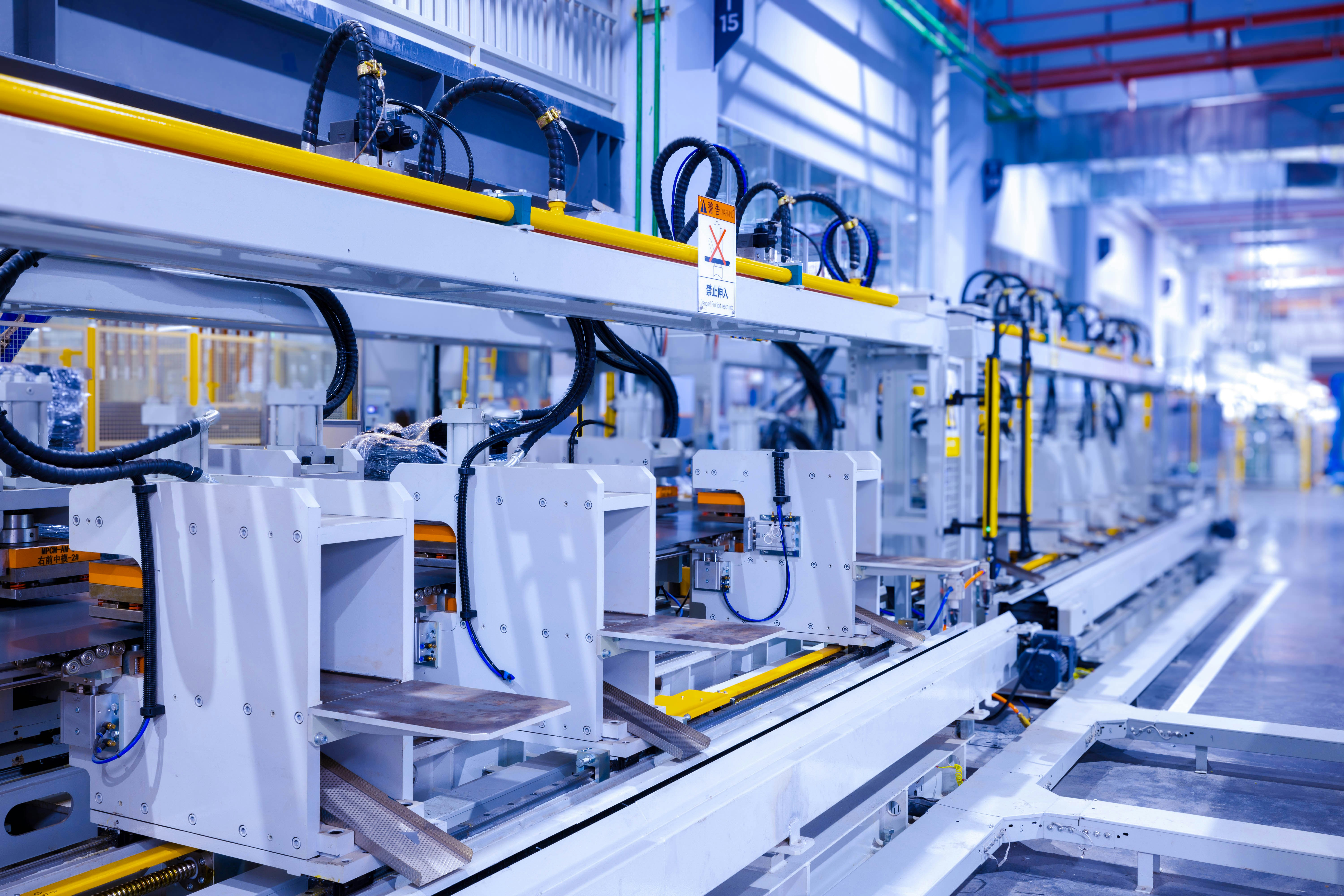
When a new factory opens, the promise is fairly straightforward: more jobs, stronger local businesses, and a better chance for families to get ahead. For communities that have lost their main employer, this promise matters. But the factory returning today may look very different from the one that closed. It may rely more on machines, need fewer workers, or require skills that former employees never had to learn. Bringing production back to America can help rebuild the middle class. The real question is whether the jobs that return will give ordinary people the security they are hoping for.
There is a real reason Americans connect factories with economic security. When a plant closes, the damage can reach beyond the people who worked there: suppliers lose orders, and nearby businesses lose customers. Economists Daron Acemoglu and his coauthors estimated that rising Chinese import competition cost the United States between 2.0 and 2.4 million jobs from 1999 to 2011, including jobs outside manufacturing. However, this does not mean China caused every factory closure. It does help explain why cheaper imported goods did not feel like progress to everyone. A lower price at the store offers little comfort to someone who has lost a dependable paycheck.1
Therefore, it may be tempting to assume that bringing factories back will undo that damage. But recovering an industry is not the same as recovering the kind of life it once supported. The difference becomes clearer when we look at what new investment actually creates and what those jobs offer workers.
The boom in construction is a useful starting point. The Treasury's chart below shows a sharp rise in spending on manufacturing buildings through April 2023, after adjusting for changes in construction-material prices. This provides evidence of a real expansion in building activity, but it does not tell us how many permanent jobs those buildings will contain. Factories also take time to finish, so their employment effects cannot be judged from construction spending alone.2
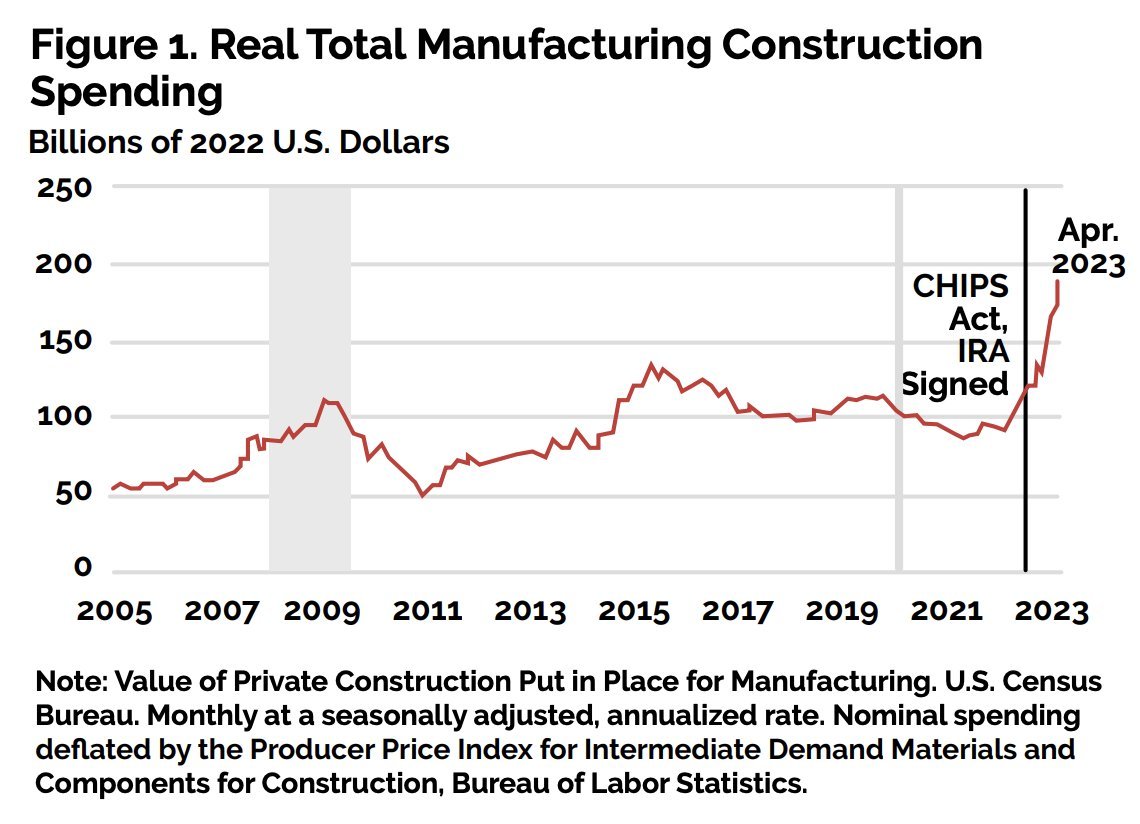
Figure 1. Factory construction spending rose sharply through April 2023. Original chart reproduced from the U.S. Treasury, using Census Bureau and BLS data. The price adjustment covers construction materials; it does not fully account for labor costs.
The next chart shines some light on the employment question. The St. Louis Fed compares manufacturing workplaces with the people they employ. Since the mid-2010s, the number of workplaces has recovered more strongly than employment. The additional factories still matter: the authors estimate that manufacturing employment would have been lower without them. But the increase in workplaces has not brought a comparable recovery in jobs, and the chart alone cannot establish how much government policy contributed to either trend.3
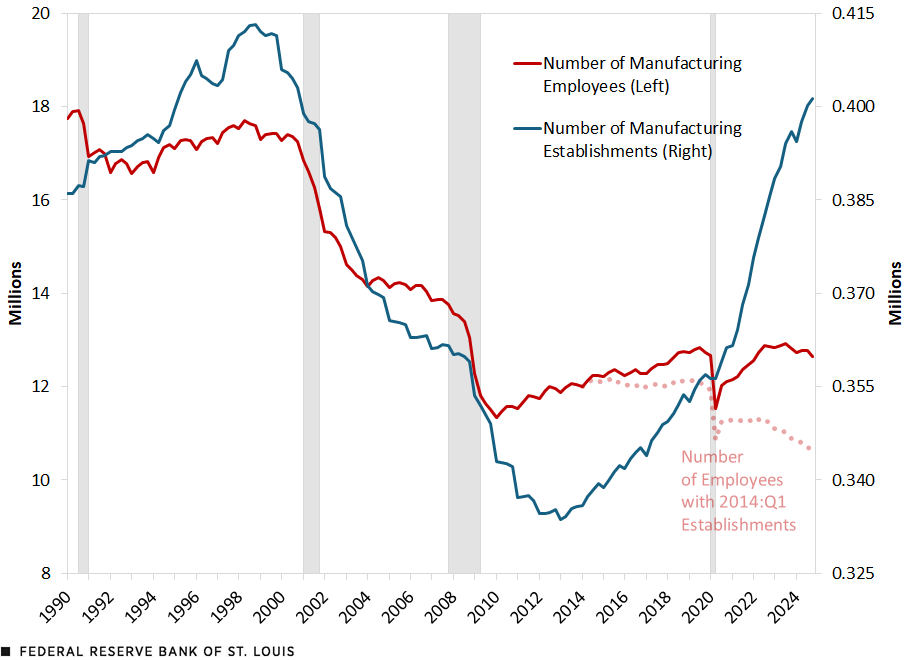
Figure 2. Manufacturing workplaces and employment, 1990–2024. Original chart from the St. Louis Fed. Red: actual employment, left axis. Blue: workplaces, right axis. The dotted line estimates employment with the number of workplaces held at its early-2014 level; it is not observed employment. The two axes have different scales.
One reason the old jobs may not return in the same form is that companies still have to compete. If producing in America costs more, a company may use machinery to reduce the labor needed to make each product. That can make domestic production possible in the first place. Greater efficiency can also lower prices, increase sales, and allow wages to rise. Therefore, the problem may not be that better technology is worse for workers, but that a successful factory may need far fewer workers than people imagine when they hear about an industrial revival.
TSMC’s Arizona expansion offers a concrete example. In April 2024, the Taiwanese chipmaker announced an investment plan exceeding $65 billion and expected approximately 6,000 direct jobs. These figures describe that announcement, not the company’s later plans or a count of jobs already created. TSMC also expected construction work and jobs at suppliers and other businesses. Even with those wider benefits, the example shows why the size of an investment alone tells us little about how many permanent jobs it will create.4
There are good reasons to value these factories anyway. Producing advanced chips in America can give American companies more access to domestic supplies. In a period of competition with China and concern about dependence on overseas production, domestic production of chips can be viewed as a necessity to quell a potential existential national security risk. Yet this fundamentally answers a different question from whether a family can afford its rent or save for the future. A project can make the country’s manufacturing base stronger without creating that many new jobs for people living nearby.5
A Federal Reserve study found that the extra hourly pay associated with manufacturing production jobs, compared with similar workers in other industries, fell from about 4 percent in the 1990s to 1.5 percent in the 2010s. This comparison accounts for differences such as education and age. It does not mean that all factory wages fell, and it does not include benefits. It shows that the pay advantage was smaller than it had been. Calling a position a manufacturing job therefore tells us too little about the life it can support.6
That raises a more practical question: what happens to the workers who get these jobs? When public money helps a company build a factory, governments should ask who will be able to work there and what those workers will earn. Paid training and partnerships with community colleges could help residents qualify without giving up an income for years. Clear commitments on pay, benefits, and advancement would make the promise of good jobs easier to evaluate. A new plant would then be judged partly by the opportunities it opens to the surrounding community.
There are also benefits beyond the factory itself. Local suppliers may gain customers, and workers may spend their earnings nearby. At the same time, temporary construction work should not be presented as permanent employment, and jobs moved from another American town should not be counted as entirely new national gains. The goal should be an honest account of how a project improves people’s lives, rather than an impressive investment announcement.
America does not necessarily have to choose between competitive factories and a strong middle class. But building more factories does not automatically bring back the security those jobs once provided. Where goods are made matters, but so does what those jobs actually provide. If workers cannot earn a secure living from them, bringing production back only solves part of the problem. The goal should be not just to build more factories, but to make sure the people around them have a real chance to build a secure life.
Notes
- Acemoglu et al., “Import Competition,” S141. ↩
- Van Nostrand, Sinclair, and Gupta, “Unpacking the Boom,” fig. 1. ↩
- Marto and Le, “Sluggish Renaissance of U.S. Manufacturing.” ↩
- Taiwan Semiconductor Manufacturing Company, “TSMC Arizona and U.S. Department of Commerce.” ↩
- Taiwan Semiconductor Manufacturing Company, “TSMC Arizona and U.S. Department of Commerce.” ↩
- Bayard et al., “Are Manufacturing Jobs Still Good Jobs?,” 9. ↩
Enjoyed this article?
Subscribe to get the latest economic analysis delivered to your inbox.
Comments
Related Articles

The Economics of Exclusivity
A pair of sneakers costing the manufacturer $100 may sell for $4,000 nowadays. In today’s drop culture, brands are turning scarcity into...

The Advantages of Photonic Technologies: A Step Closer to Sustainability Within AI Data Centers
AI data centers are driving a surge in Photonics as demand for faster, more energy-efficient technology grows.

The Housing Crisis in China: Causes, Effects, and Global Comparisons
China's housing crisis comes down to a fundamental problem: in many cities, urban shortages persist as hundreds of millions of residential...